The New York Times Times, still that bastion of good taste, just gave David Johnston a fabulous review. They also tip their gradiose hats to his other recent production of "Busted Jesus Comix."
Go and see this play! Now!
About Me

- Freeman
- Matthew Freeman is a Brooklyn based playwright with a BFA from Emerson College. His plays include THE DEATH OF KING ARTHUR, REASONS FOR MOVING, THE GREAT ESCAPE, THE AMERICANS, THE WHITE SWALLOW, AN INTERVIEW WITH THE AUTHOR, THE MOST WONDERFUL LOVE, WHEN IS A CLOCK, GLEE CLUB, THAT OLD SOFT SHOE and BRANDYWINE DISTILLERY FIRE. He served as Assistant Producer and Senior Writer for the live webcast from Times Square on New Year's Eve 2010-2012. As a freelance writer, he has contributed to Gamespy, Premiere, Complex Magazine, Maxim Online, and MTV Magazine. His plays have been published by Playscripts, Inc., New York Theatre Experience, and Samuel French.
Wednesday, January 18, 2006


The work I'm doing as we speak
A few random thoughts to share today...
The play I'm currently working on is entitled "The Most Wonderful Love." It's due for production in the early summer here in good old NYC. It's a comedy in three acts.
Now, I'm in the midst of a rewrite because the first draft had a reading that lasted just over three hours long. That's a bit of a test of any audience's patience. It also meant to me, knowing the script, that there was a great deal of fat on it.
I've been working closely with a director by the name of Kyle Ancowitz, who directed my last three act comedy "The Great Escape." That play was lean and mean. This new script has more than double the number of characters, and a wild ending, and music... you get the idea. It's a bigger play, more ambitious, but also more unruly.
By the time I've got it under control, it shouldn't seem ambitious. It should seem, well, full. Not overburdened.
Working with Kyle has been a bit of a revelation for me. Partially because I've rarely worked with a director I trusted to share my sensiblity about my work before. I've had experience with directors who have very strong opinions about my plays. But that, and the price of a cup of coffee, will buy a director... a cup of coffee. Directors should seek playwrights they trust and like to work with, just as playwrights are encouraged to guard their work closely from unwelcome influence.
One that that helps me tremendously is that this play is NOT being workshopped. I don't honestly know what the term means anymore. It sounds like a band of journeymen are approaching your precious, delicate play with a pair of pliars. It's an ugly term, and an ugly process, and yields plays that have less and less to say.
This play is being worked on precisely because Kyle will soon be directing it and his company will soon be spending money getting it on the stage. And my audience (hopefully some of you among them) will be watching it produced, not "staged" or "read." That makes a tremendous difference.
So much of this business is voodoo. What you call yourself, where you work, who is standing next to you, what sort of morning you had...how you feel and what you believe and what weird and false energies and you can bring to bear on that day to make something happen. Being on the course to production transforms the process into something that feels more like it should to me.
Anyhow, as I talk sideways about how far along I am (not as far as I tell people, but not as behind as I think I am), and work on whatever else is popping up in my head (it's usually in the midst of a rewrite I get the urge to write anything else...), I'm also trying to remember not to edit the humor out of the play, and not to assume anything about the script, and remind myself that most of what I wrote was put there by accident.
Last night I watched the first third of the Peter Brook Mahabarata on DVD Then, I put on a Windows Media playlist (Aimee Mann, Ben Folds, Bob Dylan, Tom Waits, Radiohead, Wilco right now), fiddled with my resume, rewrote the beginning of an entirely different script called "The Lower River" and the worked a bit more on tightening up "The Most Wonderful Love."
I wrote a little on the blog in between and looked at websites about LOST. And talked to my girlfriend, who is working on a mix tape.
Last night's most profound thought? It's hard to write comedy after watching a Sanskrit epic.
What are you all up to? And what, if anything, would you like to know about my plays?
The play I'm currently working on is entitled "The Most Wonderful Love." It's due for production in the early summer here in good old NYC. It's a comedy in three acts.
Now, I'm in the midst of a rewrite because the first draft had a reading that lasted just over three hours long. That's a bit of a test of any audience's patience. It also meant to me, knowing the script, that there was a great deal of fat on it.
I've been working closely with a director by the name of Kyle Ancowitz, who directed my last three act comedy "The Great Escape." That play was lean and mean. This new script has more than double the number of characters, and a wild ending, and music... you get the idea. It's a bigger play, more ambitious, but also more unruly.
By the time I've got it under control, it shouldn't seem ambitious. It should seem, well, full. Not overburdened.
Working with Kyle has been a bit of a revelation for me. Partially because I've rarely worked with a director I trusted to share my sensiblity about my work before. I've had experience with directors who have very strong opinions about my plays. But that, and the price of a cup of coffee, will buy a director... a cup of coffee. Directors should seek playwrights they trust and like to work with, just as playwrights are encouraged to guard their work closely from unwelcome influence.
One that that helps me tremendously is that this play is NOT being workshopped. I don't honestly know what the term means anymore. It sounds like a band of journeymen are approaching your precious, delicate play with a pair of pliars. It's an ugly term, and an ugly process, and yields plays that have less and less to say.
This play is being worked on precisely because Kyle will soon be directing it and his company will soon be spending money getting it on the stage. And my audience (hopefully some of you among them) will be watching it produced, not "staged" or "read." That makes a tremendous difference.
So much of this business is voodoo. What you call yourself, where you work, who is standing next to you, what sort of morning you had...how you feel and what you believe and what weird and false energies and you can bring to bear on that day to make something happen. Being on the course to production transforms the process into something that feels more like it should to me.
Anyhow, as I talk sideways about how far along I am (not as far as I tell people, but not as behind as I think I am), and work on whatever else is popping up in my head (it's usually in the midst of a rewrite I get the urge to write anything else...), I'm also trying to remember not to edit the humor out of the play, and not to assume anything about the script, and remind myself that most of what I wrote was put there by accident.
Last night I watched the first third of the Peter Brook Mahabarata on DVD Then, I put on a Windows Media playlist (Aimee Mann, Ben Folds, Bob Dylan, Tom Waits, Radiohead, Wilco right now), fiddled with my resume, rewrote the beginning of an entirely different script called "The Lower River" and the worked a bit more on tightening up "The Most Wonderful Love."
I wrote a little on the blog in between and looked at websites about LOST. And talked to my girlfriend, who is working on a mix tape.
Last night's most profound thought? It's hard to write comedy after watching a Sanskrit epic.
What are you all up to? And what, if anything, would you like to know about my plays?
Tuesday, January 17, 2006
This and that...
Been a quiet day here at the office.
I think tonight I may write up my "Why doesn't anyone seem to care about Star Wars Episode III" post tonight. Trust me, it will anger you. And it's actually about why I think they SHOULD care.
I received a DVD of the Peter Brook Mahabarata from 1989. Happy about that. Will watch about 1/3rd of it this evening.
And hopefully, I'll get to talk a little bit about my current projects. Since I seem to have heard someone in the blogosphere wanting to talk about process, I'll give it another go to put out there what I'm up to and maybe it can garner some talk.
One problem tends to be...when I write in this space about contentious issues, I tend to get a lively discussion and a lot of visitors. When I talk about what I'm writing, or even share some, no one seems all that prepared to make comments or publicly discuss it. Which is fair enough, but it's part of the reason you don't see too many people openly talking about the actual writing or directing process, probably.
Onwards and upwards.
I think tonight I may write up my "Why doesn't anyone seem to care about Star Wars Episode III" post tonight. Trust me, it will anger you. And it's actually about why I think they SHOULD care.
I received a DVD of the Peter Brook Mahabarata from 1989. Happy about that. Will watch about 1/3rd of it this evening.
And hopefully, I'll get to talk a little bit about my current projects. Since I seem to have heard someone in the blogosphere wanting to talk about process, I'll give it another go to put out there what I'm up to and maybe it can garner some talk.
One problem tends to be...when I write in this space about contentious issues, I tend to get a lively discussion and a lot of visitors. When I talk about what I'm writing, or even share some, no one seems all that prepared to make comments or publicly discuss it. Which is fair enough, but it's part of the reason you don't see too many people openly talking about the actual writing or directing process, probably.
Onwards and upwards.
"Indie" Theater - A Few Questions
Last Night, I was sitting in a room with several other reviewers from nytheatre.com.
Got a chance to meet Ross Peabody, who is a nice guy and reader of the blog and waved a cigarette in front of me as if to say "You cannot smoke this." Thanks Ross! (Honestly, pleased to meet you.)
There was quite a bit said that I found interesting and worthy of a little mention here. Not the least of which was that Martin continued to disseminate the term "Indie" Theatre as a replacement for Off-Off Broadway. It's a concerted effort to rebrand a certain sect of this tiny religion, but it's also got the benefits of being a One-Size Fits All Term. Off-Off Broadway and Off-Loop Theatre are New York and Chicago specific terms, respectively. Indie Theatre has no such limitations.
That being said, I'm curious what readers may consider accurately "indie" theater now that the term has been out there for a while. Kirk Bromley, I believe, coined the term. There was a great deal of discussion regarding it in the Fall on the ny theatre i. (Take a look and catch up here.)
I always find these discussions are best when I get off my soapbox (at least to start with) and ask questions. So here are a few I think might guide us to the era of "Indie Theatre."
1. What should be excluded and included from "Indie" Theatre? Is that simply a label that can be handed out for Street Cred, or is their some economic limit on it? *(Examples: Robert Wilson works in Lincoln Center and BAM. Richard Foreman works out of tiny spaces in the East Village? Are one of these more "Indie" than the other? Is Scott Eliott (who is directing the new Threepenny Opera) a part of the Independent Theater scene, or is he "too successful?")
2. Is "Indie Theatre" a term that applies primarily to what used to be called Off-Off Broadway, or is it a nationally applicable label?
3. What is the difference between community theatre and independent theatre?
4. What will changing this name do for the theater community?
5. What won't changing this name do for the theater community?
Got a chance to meet Ross Peabody, who is a nice guy and reader of the blog and waved a cigarette in front of me as if to say "You cannot smoke this." Thanks Ross! (Honestly, pleased to meet you.)
There was quite a bit said that I found interesting and worthy of a little mention here. Not the least of which was that Martin continued to disseminate the term "Indie" Theatre as a replacement for Off-Off Broadway. It's a concerted effort to rebrand a certain sect of this tiny religion, but it's also got the benefits of being a One-Size Fits All Term. Off-Off Broadway and Off-Loop Theatre are New York and Chicago specific terms, respectively. Indie Theatre has no such limitations.
That being said, I'm curious what readers may consider accurately "indie" theater now that the term has been out there for a while. Kirk Bromley, I believe, coined the term. There was a great deal of discussion regarding it in the Fall on the ny theatre i. (Take a look and catch up here.)
I always find these discussions are best when I get off my soapbox (at least to start with) and ask questions. So here are a few I think might guide us to the era of "Indie Theatre."
1. What should be excluded and included from "Indie" Theatre? Is that simply a label that can be handed out for Street Cred, or is their some economic limit on it? *(Examples: Robert Wilson works in Lincoln Center and BAM. Richard Foreman works out of tiny spaces in the East Village? Are one of these more "Indie" than the other? Is Scott Eliott (who is directing the new Threepenny Opera) a part of the Independent Theater scene, or is he "too successful?")
2. Is "Indie Theatre" a term that applies primarily to what used to be called Off-Off Broadway, or is it a nationally applicable label?
3. What is the difference between community theatre and independent theatre?
4. What will changing this name do for the theater community?
5. What won't changing this name do for the theater community?
Saturday, January 14, 2006
The Smirnoff Branding Story
My good friend Matt Banos noticed that I was discussing the "Smirnoff" story he told me a while back, regarding how to widen the audience through contemporary branding and marketing. He sent this link to the facts.
Thanks Matt! Say hi to the Nubia and Alex for me!
Thanks Matt! Say hi to the Nubia and Alex for me!
Friday, January 13, 2006
Jesse The Body...Eat Your Heart Out
I bet Norm Coleman is thinking "Oh No! Not again!"
Here is the Dark Lord of Minnesota.
As my father is a the Rector of this Parish in Minnesota, I cannot endorse this man's candidacy. As much as I wish I could.
Here is the Dark Lord of Minnesota.
As my father is a the Rector of this Parish in Minnesota, I cannot endorse this man's candidacy. As much as I wish I could.
Thursday, January 12, 2006
Richard Foreman and Branding
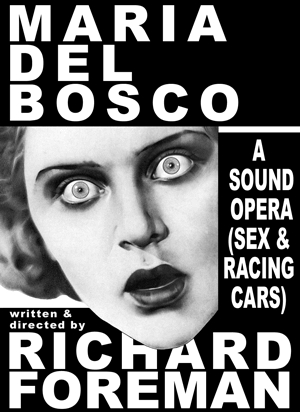


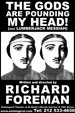
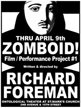 I think George Hunka and I may have finally found a place we meet regarding Richard Foreman. A lightbulb just went on.
George has noted that, despite some misgivings that have been expressed about whether or not certain theatre (Richard Foreman explictly) is inclusive or elitist, Foreman happens to pack his runs with audience. On Theatre Ideas George notes, quite rightly, that Foreman must be doing something right.
And I contend that it is... branding. That Foreman is a New York City brand, whose posters can be seen covering the city whenever his productions are on the way, which is every twenty minutes. They cover the walls of any available surface, and they have a distinct look. One that says "Enter here, all ye wacky New York Theatre Artists and Downtown Scene-sters. I am Foreman, and I am ubiquitous." He promises a "Richard Foreman experience." His name is his Brand.
Note the posters above and you'll see that Foreman's name is prominently displayed. Also, there is a consistency to the style and iconography. This is the epitome of branding. Ask any college student wandering around NYU who Richard Foreman is, and what his next show is, and they'll at least try to remember what they read on one of his posters. They are aware of him, and that is how he maintains his audience. Image, in a nation without state funding of any consequence, matters.
I would like to add that this is not a judgement on the quality of Foreman's work, which is unique and an acquired taste and certainly valuable. This is to highlight that an artist as bizarre and unique as Foreman advertises, and advertises like no other theater producer/director/writer in New York does.
I stand corrected therefore. We can all learn a tremendous amount from him.
Narrative as an Invitation
From Superfluities, talking about Manet:
"What does all this have to do with theater and drama? Well, one of the things it points out it is how far our drama is behind the other arts, about 150 years behind painting in this case. Most of our drama is still playing with Victorian narrative form; as much as there are jokes around the edges of it, "playing with form," that form is not abandoned nearly as much as Manet abandoned conventions of narrative and allegory in 19th-century French painting. But there's more, too: there's the emphasis on light and shadow, rather than shape and detail; and, of course, the implication of the viewer. Manet's nude challenges us to enter the painting, accepting the impossibility of interpreting it, of assuming that if we do so it will grant us meaning. It doesn't. Foreman, too, places people on the stage, staring out at us, inviting us into that world, and we too can reject that meaninglessness, if we wish to do so. But the sensual pleasures it offers in our entering the world of the painting, without preconceived notions, can be revolutionary in changing our way of seeing, as Manet changed the art of painting."
I think that an important point is brought up here (although I don't necessarily agree with the interpretations of the painting or how George interprets Foreman). I believe that narrative is something that we are tied to, by and large, in the theatre, in a way that we rarely reconsider.
Narrative is viewed by almost everyone one in the theatre as almost the same thing as a play. A play is a form of a narrative. Just another way to tell a story.
Observance is inherent, but narrative is a form. We use forms of narrative (comedy, tragedy) the way we use makeup. It is a way to direct the viewers observation. It is a tried and true method to show something to the viewer that, in fact, invites them into something familiar, so that those who observe feel complicit in and engaged by what is being shown to them.
I believe that narrative is something that is handled best by Television and Film, and that Poetry and Visual Art, for the most part, eschew direct narrative as a matter of course. Theatre should consider viewing narrative in a new way, and that might help it distinguish itself more fully and excitingly than other mediums that utilize storytelling.
Here is where George and I diverge: Foreman, who sees narrative as something that needs to be challenged, doesn't seem to invite the audience into his insular world. I find this often true of non-narrative theatre that I've seen... it is distancing, and elitist, and makes no effort to make its symbols or images or words ring true for the casual observer.
Is it possible to invite an audience into non-narrative theatre? To make them complicit and involved, without self-indulgence?
"What does all this have to do with theater and drama? Well, one of the things it points out it is how far our drama is behind the other arts, about 150 years behind painting in this case. Most of our drama is still playing with Victorian narrative form; as much as there are jokes around the edges of it, "playing with form," that form is not abandoned nearly as much as Manet abandoned conventions of narrative and allegory in 19th-century French painting. But there's more, too: there's the emphasis on light and shadow, rather than shape and detail; and, of course, the implication of the viewer. Manet's nude challenges us to enter the painting, accepting the impossibility of interpreting it, of assuming that if we do so it will grant us meaning. It doesn't. Foreman, too, places people on the stage, staring out at us, inviting us into that world, and we too can reject that meaninglessness, if we wish to do so. But the sensual pleasures it offers in our entering the world of the painting, without preconceived notions, can be revolutionary in changing our way of seeing, as Manet changed the art of painting."
I think that an important point is brought up here (although I don't necessarily agree with the interpretations of the painting or how George interprets Foreman). I believe that narrative is something that we are tied to, by and large, in the theatre, in a way that we rarely reconsider.
Narrative is viewed by almost everyone one in the theatre as almost the same thing as a play. A play is a form of a narrative. Just another way to tell a story.
Observance is inherent, but narrative is a form. We use forms of narrative (comedy, tragedy) the way we use makeup. It is a way to direct the viewers observation. It is a tried and true method to show something to the viewer that, in fact, invites them into something familiar, so that those who observe feel complicit in and engaged by what is being shown to them.
I believe that narrative is something that is handled best by Television and Film, and that Poetry and Visual Art, for the most part, eschew direct narrative as a matter of course. Theatre should consider viewing narrative in a new way, and that might help it distinguish itself more fully and excitingly than other mediums that utilize storytelling.
Here is where George and I diverge: Foreman, who sees narrative as something that needs to be challenged, doesn't seem to invite the audience into his insular world. I find this often true of non-narrative theatre that I've seen... it is distancing, and elitist, and makes no effort to make its symbols or images or words ring true for the casual observer.
Is it possible to invite an audience into non-narrative theatre? To make them complicit and involved, without self-indulgence?
Wednesday, January 11, 2006
Essay Questions for Bad Poetry #2
And now, another beautiful work of wordplay. This one by Jimmy Stewart. Remember kids, there's extra credit...
"Beau"
by Jimmy Stewart
He never came to me when I would call
Unless I had a tennis ball,
Or he felt like it,
But mostly he didn't come at all.
When he was young
He never learned to heel
Or sit or stay,
He did things his way.
Discipline was not his bag
But when you were with him things sure didn't drag.
He'd dig up a rosebush just to spite me,
And when I'd grab him, he'd turn and bite me.
He bit lots of folks from day to day,
The delivery boy was his favorite prey.
The gas man wouldn't read our meter,
He said we owned a real man-eater.
He set the house on fire
But the story's long to tell.
Suffice it to say that he survived
And the house survived as well.
On the evening walks, and Gloria took him,
He was always first out the door.
The Old One and I brought up the rear
Because our bones were sore.
He would charge up the street with Mom hanging on,
What a beautiful pair they were!
And if it was still light and the tourists were out,
They created a bit of a stir.
But every once in a while, he would stop in his tracks
And with a frown on his face look around.
It was just to make sure that the Old One was there
And would follow him where he was bound.
We are early-to-bedders at our house--
I guess I'm the first to retire.
And as I'd leave the room he'd look at me
And get up from his place by the fire.
He knew where the tennis balls were upstairs,
And I'd give him one for a while.
He would push it under the bed with his nose
And I'd fish it out with a smile.
And before very long
He'd tire of the ball
And be asleep in his corner
In no time at all.
And there were nights when I'd feel him
Climb upon our bed
And lie between us,
And I'd pat his head.
And there were nights when I'd feel this stare
And I'd wake up and he'd be sitting there
And I reach out my hand and stroke his hair.
And sometimes I'd feel him sigh
and I think I know the reason why.
He would wake up at night
And he would have this fear
Of the dark, of life, of lots of things,
And he'd be glad to have me near.
And now he's dead.
And there are nights when I think I feel him
Climb upon our bed and lie between us,
And I pat his head.
And there are nights when I think
I feel that stare
And I reach out my hand to stroke his hair,
But he's not there.
Oh, how I wish that wasn't so,
I'll always love a dog named Beau.
Essay Questions
1. Jimmy Stewart appears to have had a dog that, when he wrote this poem, he missed. The dog's name was "Beau." Why do people bother to write poems like this one?
2. The bit where Stewart says he understands the dog's fear... did that creep you out? Why or why not?
3. At one point in this poem, Stewart reveals that Beau once set his childhood home on fire. This sounds like a fairly interesting story. Why does he only play with our figurative nipples? We are never going to have an orgasm (poetically speaking) that way.
4. Often, being cryptic is a way to assign several meanings to a phrase or to let the phrase take on more than a very literal telling can sustain. Keeping this in mind, why does Stewart use the cryptic phrase "The Old One?" Why doesn't he just spare us the eye-rolling and say what the fuck he's talking about?
5. When Stewart rhymes "bag" and "drag"... why do I feel a slight pain in my left arm?
Extra Credit!
Did your mother ever tell who Jimmy Stewart was? It's amazing that you don't know. No one should have been born in the 1990s. (Explain why, you infant.)
"Beau"
by Jimmy Stewart
He never came to me when I would call
Unless I had a tennis ball,
Or he felt like it,
But mostly he didn't come at all.
When he was young
He never learned to heel
Or sit or stay,
He did things his way.
Discipline was not his bag
But when you were with him things sure didn't drag.
He'd dig up a rosebush just to spite me,
And when I'd grab him, he'd turn and bite me.
He bit lots of folks from day to day,
The delivery boy was his favorite prey.
The gas man wouldn't read our meter,
He said we owned a real man-eater.
He set the house on fire
But the story's long to tell.
Suffice it to say that he survived
And the house survived as well.
On the evening walks, and Gloria took him,
He was always first out the door.
The Old One and I brought up the rear
Because our bones were sore.
He would charge up the street with Mom hanging on,
What a beautiful pair they were!
And if it was still light and the tourists were out,
They created a bit of a stir.
But every once in a while, he would stop in his tracks
And with a frown on his face look around.
It was just to make sure that the Old One was there
And would follow him where he was bound.
We are early-to-bedders at our house--
I guess I'm the first to retire.
And as I'd leave the room he'd look at me
And get up from his place by the fire.
He knew where the tennis balls were upstairs,
And I'd give him one for a while.
He would push it under the bed with his nose
And I'd fish it out with a smile.
And before very long
He'd tire of the ball
And be asleep in his corner
In no time at all.
And there were nights when I'd feel him
Climb upon our bed
And lie between us,
And I'd pat his head.
And there were nights when I'd feel this stare
And I'd wake up and he'd be sitting there
And I reach out my hand and stroke his hair.
And sometimes I'd feel him sigh
and I think I know the reason why.
He would wake up at night
And he would have this fear
Of the dark, of life, of lots of things,
And he'd be glad to have me near.
And now he's dead.
And there are nights when I think I feel him
Climb upon our bed and lie between us,
And I pat his head.
And there are nights when I think
I feel that stare
And I reach out my hand to stroke his hair,
But he's not there.
Oh, how I wish that wasn't so,
I'll always love a dog named Beau.
Essay Questions
1. Jimmy Stewart appears to have had a dog that, when he wrote this poem, he missed. The dog's name was "Beau." Why do people bother to write poems like this one?
2. The bit where Stewart says he understands the dog's fear... did that creep you out? Why or why not?
3. At one point in this poem, Stewart reveals that Beau once set his childhood home on fire. This sounds like a fairly interesting story. Why does he only play with our figurative nipples? We are never going to have an orgasm (poetically speaking) that way.
4. Often, being cryptic is a way to assign several meanings to a phrase or to let the phrase take on more than a very literal telling can sustain. Keeping this in mind, why does Stewart use the cryptic phrase "The Old One?" Why doesn't he just spare us the eye-rolling and say what the fuck he's talking about?
5. When Stewart rhymes "bag" and "drag"... why do I feel a slight pain in my left arm?
Extra Credit!
Did your mother ever tell who Jimmy Stewart was? It's amazing that you don't know. No one should have been born in the 1990s. (Explain why, you infant.)
Phantom of the Opera wins the Race
Well, as case-in-point about how relevant Broadway is to the theatrical world at large, I would like to 1. mention that Phantom of the Opera is now the longest-ever running Broadway Musical 2. ask if anyone who reads this blog has thought much about Phantom since 1989?
A Nice Cup of Coffee
I received an e-mail this morning that an adaptation of mine is being considered for publication in a proposed anthology. Nothing set in stone, but it's nice to think of more publication. Especially of that particular oddball script. It's dear to my heart.
I won't bother with too much detail, as it may not happen. But it was a nice cup of coffee as I settled into my desk job this morning.
I won't bother with too much detail, as it may not happen. But it was a nice cup of coffee as I settled into my desk job this morning.
Tuesday, January 10, 2006
The New Audience
Well this has been quite a way to start the New Year: an expanding conversation regarding "The Audience."
It started over at Superfluities, then took a turn here and at Theatre Ideas, then MattJ at Theatre Conversation. Now, I've received thoughtful comments from both Don Hall out of Chicago (Hello there, Don) and Allison Croggon at Theatre Notes (from the land of the Cane Toad.)
As a part of this continuing discussion, I'd like to direct attention to Don Hall's post "Is American Theater Relevant?" and to a piece I wrote at the beginning of December, which received only a single response from the intrepid Joshua James. (Whew, that's a lot of links.)
Anyhow... Allison Croggon sort of brings the conversation full circle by referencing how poetry has often been viewed as losing its cultural significance in a similar way, and talking about the combination of factors ("a matrix of perception") that contribute to the distancing of theater from the audience.
I wholeheartedly agree that it isn't the fault of the artists, for the most part, that poetry is taught as if it is dense and difficult, and theatre is taught like "what there was before TV." But I fear that by stepping back again and again and saying "This is not our fault" we are not helping our cause. It is also no help to view the audience as somehow lost to us, or growing inevitably smaller. It is no help to revert to more and more specialized, internalized forms of expression, designed to appeal to the few, the well-read, and the privileged.
What I am inferring, not only on the blogsphere, but in the Indie Theatre world at large, is that the audience is intrusive, and that the larger the audience becomes, the less discerning and possible to communicate with they become. That to be true to oneself, one must put the audience out of mind, or reduce the audience in size to a single pair of eyes.
I hear, often, frustration with how some people make theater. I'm not all that interested in how theatre is made as long as the finished result is good theatre. What is good theatre, also, is entirely subjective. To argue with someone else's process, or their preferences, is like arguing with the history of another person's life.
What I find alarming is the general disinterest of theatre artists in the overall disinterest of the general public. There is interesting, punk rock, tear 'em up, broken down, catch-as-catch-can theatre that will not only appeal to a great number of people who are not seeing it, but that they aren't even aware is out there.
I feel that this disinterest manifests itself in a sort of general *sigh* from most educated artists. As if they are saying "I don't care anymore who listens. They have iPods and computers now. All I want is one person to listen, one truly educated listener, and I will be satisfied."
Ask for the very least, and I promise, you will be able to get it.
It is time for us to stop speaking about the audience as either opponents, or patients. It's also time to put the brakes on viewing our audience as a single pair of eyes, looking over our shoulder, in an empty room.
It's time for us to talk about, think about, and dedicate ourselves to capturing a new audience, a generation of new audience.
Yes, there are obstacles that have come between us and them. Let's look at those obstacles, see them for what they are, and figure out how to overcome them.
I think that there is room on the stage for theatre of which Brecht would have approved, and also theatre with which he would have clean his bathroom sink. There is lots of dreadful music out there, and there is an audience for it. The important thing is not to suddenly turn all theatre into works of pre-approved genius, but to get enough interest so that we can weather the storms of bad reviews and get eyeballs on the things that are worth seeing.
There is one 'fact-ette' that I'd like to note to start some discussion about this...
Vodka: A good friend of mine who is a consultant and generally successful business-type, named Matthew Banos, once told me a story about how the vodka industry turned around its economic fortures. (This may or may not be apocraphal, but I tend to trust him.)
What he told me was that up until the mid-to-late eighties, Smirnoff (or somesuch Vodka producer) was not setting the world on fire with its sales. It was considered cheap liquor, and was sold at a low price. The solution was to get a nice fancy new label and raise the price.
Of course, the actual item didn't change. But the sales did. When this particular brand of Vodka suddenly priced itself as if it was expensive, it was suddenly on the shopping list of those with more money to spend.
It started over at Superfluities, then took a turn here and at Theatre Ideas, then MattJ at Theatre Conversation. Now, I've received thoughtful comments from both Don Hall out of Chicago (Hello there, Don) and Allison Croggon at Theatre Notes (from the land of the Cane Toad.)
As a part of this continuing discussion, I'd like to direct attention to Don Hall's post "Is American Theater Relevant?" and to a piece I wrote at the beginning of December, which received only a single response from the intrepid Joshua James. (Whew, that's a lot of links.)
Anyhow... Allison Croggon sort of brings the conversation full circle by referencing how poetry has often been viewed as losing its cultural significance in a similar way, and talking about the combination of factors ("a matrix of perception") that contribute to the distancing of theater from the audience.
I wholeheartedly agree that it isn't the fault of the artists, for the most part, that poetry is taught as if it is dense and difficult, and theatre is taught like "what there was before TV." But I fear that by stepping back again and again and saying "This is not our fault" we are not helping our cause. It is also no help to view the audience as somehow lost to us, or growing inevitably smaller. It is no help to revert to more and more specialized, internalized forms of expression, designed to appeal to the few, the well-read, and the privileged.
What I am inferring, not only on the blogsphere, but in the Indie Theatre world at large, is that the audience is intrusive, and that the larger the audience becomes, the less discerning and possible to communicate with they become. That to be true to oneself, one must put the audience out of mind, or reduce the audience in size to a single pair of eyes.
I hear, often, frustration with how some people make theater. I'm not all that interested in how theatre is made as long as the finished result is good theatre. What is good theatre, also, is entirely subjective. To argue with someone else's process, or their preferences, is like arguing with the history of another person's life.
What I find alarming is the general disinterest of theatre artists in the overall disinterest of the general public. There is interesting, punk rock, tear 'em up, broken down, catch-as-catch-can theatre that will not only appeal to a great number of people who are not seeing it, but that they aren't even aware is out there.
I feel that this disinterest manifests itself in a sort of general *sigh* from most educated artists. As if they are saying "I don't care anymore who listens. They have iPods and computers now. All I want is one person to listen, one truly educated listener, and I will be satisfied."
Ask for the very least, and I promise, you will be able to get it.
It is time for us to stop speaking about the audience as either opponents, or patients. It's also time to put the brakes on viewing our audience as a single pair of eyes, looking over our shoulder, in an empty room.
It's time for us to talk about, think about, and dedicate ourselves to capturing a new audience, a generation of new audience.
Yes, there are obstacles that have come between us and them. Let's look at those obstacles, see them for what they are, and figure out how to overcome them.
I think that there is room on the stage for theatre of which Brecht would have approved, and also theatre with which he would have clean his bathroom sink. There is lots of dreadful music out there, and there is an audience for it. The important thing is not to suddenly turn all theatre into works of pre-approved genius, but to get enough interest so that we can weather the storms of bad reviews and get eyeballs on the things that are worth seeing.
There is one 'fact-ette' that I'd like to note to start some discussion about this...
Vodka: A good friend of mine who is a consultant and generally successful business-type, named Matthew Banos, once told me a story about how the vodka industry turned around its economic fortures. (This may or may not be apocraphal, but I tend to trust him.)
What he told me was that up until the mid-to-late eighties, Smirnoff (or somesuch Vodka producer) was not setting the world on fire with its sales. It was considered cheap liquor, and was sold at a low price. The solution was to get a nice fancy new label and raise the price.
Of course, the actual item didn't change. But the sales did. When this particular brand of Vodka suddenly priced itself as if it was expensive, it was suddenly on the shopping list of those with more money to spend.
Monday, January 09, 2006
Cyber Romance Poetry
This is the greatest website in the history of websites.
Teen Poetry dedicated to Romance over the Internet. No, I'm not kidding.
It's a generation of heavyset 'Cyrano's.
Teen Poetry dedicated to Romance over the Internet. No, I'm not kidding.
It's a generation of heavyset 'Cyrano's.
Essay Questions for Bad Poetry #1
The following will be the first in a series of (as I am inspired) essay questions for young high school literature students, who are studying the work of the very worst writers I can come across.
This was written for Hallmark. To be fair.
Now let's read this poem together, shall we? We will use, for the purposes of this exercise, only the front of the card, because it stops rhyming when you open it up.
Finding Time For Friendship
Finding time for friendship
can be difficult these days...
when calendars and schedules
keep us going separate ways.
When eons seem to come between
a visit or a chat,
real friendship doesn't fade away
and we depend on that!
Through every stress and hassle
we count on friends to care,
and when a crisis happens
friends will be the first ones there.
Less important things can wait...
because our peace of mind depends
on giving ourselves the gift
of time to be with friends.
Essay Questions
1. In this poem, the poet seems to think something is very important. What is it?
2. The word "eons" seems an odd choice here because even a human being in excellent health can barely make it to 100 years old. Explain the self-importance this word implies.
3. What do you think the poet's friends are like? Would you like to be friends with them? Why or why not?
4. There are two points in the poem where the poet uses ellipses. Usually, ellipses are used to show that a thought is being artfully left out. Is the poet withholding something from the reader? If so, do you think her goal is create a sense of nameless dread?
5. Justify the exclamation point. I fucking dare you.
Extra Credit! What else rhymes with "friends?"
This was written for Hallmark. To be fair.
Now let's read this poem together, shall we? We will use, for the purposes of this exercise, only the front of the card, because it stops rhyming when you open it up.
Finding Time For Friendship
Finding time for friendship
can be difficult these days...
when calendars and schedules
keep us going separate ways.
When eons seem to come between
a visit or a chat,
real friendship doesn't fade away
and we depend on that!
Through every stress and hassle
we count on friends to care,
and when a crisis happens
friends will be the first ones there.
Less important things can wait...
because our peace of mind depends
on giving ourselves the gift
of time to be with friends.
Essay Questions
1. In this poem, the poet seems to think something is very important. What is it?
2. The word "eons" seems an odd choice here because even a human being in excellent health can barely make it to 100 years old. Explain the self-importance this word implies.
3. What do you think the poet's friends are like? Would you like to be friends with them? Why or why not?
4. There are two points in the poem where the poet uses ellipses. Usually, ellipses are used to show that a thought is being artfully left out. Is the poet withholding something from the reader? If so, do you think her goal is create a sense of nameless dread?
5. Justify the exclamation point. I fucking dare you.
Extra Credit! What else rhymes with "friends?"
The Audience
I was recently reading a few of George Hunka's posts on Howard Barker (notably here and here) and in his usual grandiloquent style, George speaks about what the artist should be doing to knock the audience out of its complacency and challenge its comfortable assumptions. I made a crack in his comments that references "The Matrix" movies, because hey, that's what it made me think of. No harm intended.
Now, some of what George is saying is naturally true: it doesn't do much good for an artist to simply confirm the worldview of his audience, or just perform a weightless song-and-dance routine. But, as usual, I found myself a little at odds with, perhaps feeling simply resistant to, what George was writing here.
I asked myself why, for once, because I'm not a person that I think has vastly different tastes than George. Maybe we don't agree on Foreman, but we're both fans of Beckett and Pinter, and we both believe in challenging theatre that is not simply "entertainment."
What I finally arrived at as the foundation of my discomfort was the repetition of the term "the audience" and the way it is used. How Scott Walters also speaks of what "the audience" wants and needs, and how George seems to think Scott is making things too easy on the crowds (It is, in fact, the title of the post.)
The audience is not one thing. An audience can be different from Wednesday to Thursday for one show. Then again, the entire "audience" for one writer may not be the same "audience" for another.
But, the audience is the center of the theatrical world. Not the artist, but the audience. What we do has an effect on spectators, onlookers, who often have specifically chosen to come and experience and observe whatever it is we are presenting. They are, rightly, our obsession. And like any obsession, sometimes, it makes us hostile.
While this could be an endless topic, I'd like to at least get one started. Here are a few questions and comments to perhaps inspire some response.
I'll be happy to try my hand at answering those questions, soon enough. But I thought maybe, before I did, I'd just put this out there.
Now, some of what George is saying is naturally true: it doesn't do much good for an artist to simply confirm the worldview of his audience, or just perform a weightless song-and-dance routine. But, as usual, I found myself a little at odds with, perhaps feeling simply resistant to, what George was writing here.
I asked myself why, for once, because I'm not a person that I think has vastly different tastes than George. Maybe we don't agree on Foreman, but we're both fans of Beckett and Pinter, and we both believe in challenging theatre that is not simply "entertainment."
What I finally arrived at as the foundation of my discomfort was the repetition of the term "the audience" and the way it is used. How Scott Walters also speaks of what "the audience" wants and needs, and how George seems to think Scott is making things too easy on the crowds (It is, in fact, the title of the post.)
The audience is not one thing. An audience can be different from Wednesday to Thursday for one show. Then again, the entire "audience" for one writer may not be the same "audience" for another.
But, the audience is the center of the theatrical world. Not the artist, but the audience. What we do has an effect on spectators, onlookers, who often have specifically chosen to come and experience and observe whatever it is we are presenting. They are, rightly, our obsession. And like any obsession, sometimes, it makes us hostile.
While this could be an endless topic, I'd like to at least get one started. Here are a few questions and comments to perhaps inspire some response.
- What makes someone buy a ticket to go and see a play?
- Is your audience different from someone else's?
- How does a contemporary individual "see" a play, as opposed to an individual whelped on radio?
- Do you think of the audience when you write or direct or act?
- Do you actually like "the audience" and "the crowd?"
- I hear a lot of talk about shaking up the crowd, etc. It sometimes feels like we view art as a cure to some sickness "the audience" suffers from.
- Is the artist intended to impose his imagination on the spectators, or inspire the imagination of the spectators?
- What is the difference between "the audience" and "the spectators?"
I'll be happy to try my hand at answering those questions, soon enough. But I thought maybe, before I did, I'd just put this out there.
Candy & Dorothy
Anyone who lives in the New York area should do themselves the favor of seeing David Johnston's newest play "Candy and Dorothy." Information is here.
David is a fantastic writer. His most recently produced play was "Busted Jesus Comix" which received a rave review from the Times. He's one of those rare writers who has wit and compassion and something very important to say.
David is a fantastic writer. His most recently produced play was "Busted Jesus Comix" which received a rave review from the Times. He's one of those rare writers who has wit and compassion and something very important to say.
Wednesday, January 04, 2006
An Interview with Jessica Applebaum, Dramaturg
I've recently had the good fortune of coming across the young theatre company called One Year Lease. Just before the end of the 2005, they produced three versions of Phaedra, the program being entitled, "Phaedra x 3."
Jessica Applebaum, the Dramaturg for One Year Lease and for the Phaedra Project, agreed to be interviewed in this space. I felt it was an excellent opportunity to speak with an individual whose role as Dramaturg gives her a unique perspective on the artistic process of a company that works with classic texts. Also, to ask questions about Dramaturgy, which is a task that, in and of itself, is seldom given its due.
Below are my questions (such as they are) and Jessica's very thoughtful answers. I think attention should be especially paid to her definition of the often unconsidered term "Classic" and her response to why Classic texts specifically appeal to her.
Tell me about how you came to be associated with One Year Lease and Phaedra?
In the fall of 2000 I was walking out of the documentary company where I worked to grab some lunch and ran into Ianthe Demos (Artistic Director/Director). – Ianthe and I had taken courses together at Vassar in the theatre department and our senior year had collaborated with Gabrielle Cody on a (re) making of Chuck Mee’s Orestes 2.0. – We stepped into a Chinese restaurant to catch up on what was happening in our lives post college. Ianthe told me she and Ari Barbanell (Artistic Director/Actor) had started a theatre company with fellow Vassar alumnus, One Year Lease. They were beginning to work on their next production – Jean Anoulih’s Antigone and I was asked if I wanted to come on board to dramaturg.
And how was that first experience with them, working as the dramaturg on Antigone?
Wow. That was a while ago … I am trying to place myself in that specific production since we reconceived the play four years later.
Of course an understanding of the political climate of Anouilh’s Antigone was also of great import to the project, that goes without saying…
In 2000 we used Lewis Galantiere’s translation. In 2004 Marie-Pierre Beausejour a brilliant actor that we had worked with in Machinal is also a translator. As we began rehearsals in 2004 (she played the Chorus) we kept talking about the differences between Anouilh's and Galantiere's Antigone. She went back to her apartment and came to us with a new translation to work with
Anyhow, one of the major projects I worked on in 2000 was reading Anouilh’s play in its original language and then bringing to light choices Galantiere made in his translation.
I love the complexity of French as a language. Words are very specifically gendered in a way that the English language is not. As well certain words used in certain contexts have multiple meanings, so the person translating the text from French into English is not merely translating it. He or she (at times) is often forced or compelled to make a singular choice of a words meaning based on the limitations of English as a language. It was important for me to present our production team with the multiple meanings and readings the French language created.
I was excited to see that the work I brought to them began to appear in their conceptions of how to design the show - how to show these double entendres and metaphors and codes in the design of the show.
Soon after the production was over I was asked if I wanted to become a member of the company, which I immediately said yes to.
From my first day in the rehearsal room and our first design meeting, I knew that One Year Lease’s integrity to the medium of theatre – the plays it chooses to perform, the actors and designers it chooses to work with and for – was an opportunity I wanted to both be a part of and to support.
You say something interesting here, which is “the actors and designers it chooses to work with and for...” It’s rare to hear it expressed that a company works for the actors and designers.
Companies can and do work with a group of practitioners to create plays – but I would suggest a differentiation then between a theatre company and a producing body …
One Year Lease is a theatre company. We are invested in our practitioners. We work for our actors, for our designers, for our director (from both an artistic as well as a producing perspective). We want and I believe are successful at creating a ensemble of actors and designers who continue to challenge each other and make us stronger practitioners.
It’s a matter of respect to them as well as to the medium we choose to work in.
As for my association with Phaedra x 3 … Throughout the years as we end one production we immediately begin to think of what we want to perform/produce next. In 2004 our second run/reinterpretation of Antigone for the UnConvention ended. Our company members were asked to bring plays to the table for the coming year. With the political climate as it was I was interested in performing Kafka’s Trial.
Then, Ianthe and I took a trip to Greece for Christmas. We were walking along the river below the villages of Papingo, where her family has been part of the community since Ianthe was a little girl. Looking at our surroundings and discussing the openness, care and curiosity that the village had for us, we realized that whatever OYL’s next project would be we were bringing it to these mountains. We would live and rehearse among the villages of Papingo, perform for them, and then bring the project back to New York.
It made sense then for us to go back and ask our company members to bring us plays that were either Greek or based on a Greek myth. One of our members, Jackie Kristel, brought Ianthe Sarah Kane’s Phaedra’s Love. When Ianth became intrigued by the challenges Sarah Kane provides (especially for her as a director) I said to her, “If you liked and were interested in Kane’s play you must read Matthew Maguire’s Phaedra.” I had read the play my senior year of college and fell in love with Matthew’s adaptation of the myth – and had been wanting one day to help bring it to life.
Very soon after Maguire’s play was read, Ianthe came to me and said, “I have a crazy idea.” She had the Hughes translation of Racine’s Phedre, Maguire’s Phaedra, and Sarah Kane’s Phaedra’s Love in her hand. “A rep of six actors, performing all three, rehearsing in Greece…”
Who could say no to that?
What about Phaedra do you personally connect with?
The struggle between desire and pride.
Desire is a very isolated emotion that one has little control of, that bleeds into the world one engages with … Pride as well isolates one from communicating one’s thoughts and emotions freely, it often halts one from saying everything that is needed in a social situation. The struggle between Phaedra and Hippolytus is as human as drama gets and is what I connect to with this story.
What was your role, specifically, as a Dramaturg?
In the beginning I think one of my integral roles was to help choose the three Phaedras that we were going to perform. One Year Lease is dedicated to performing classic texts. Classic for us is defined as a play that is necessary, durable, and urgent. One of the beauties of this project was to actually perform our mission statement. To chose three texts that spoke to each other and to the fact that they have been interpreted and performed by playwrights from different eras, cultures and values. These three plays in particular spoke to the breadth of the Phaedra myth and to our definition of classic.
In terms of my role during the actual rehearsals and production, I felt that for this project what was of the utmost importance was for me to go back to the myth and provide a solid background of who these characters are (where they come from, how they are related to each other) to our actors. As well I believed it was integral to give them a background of the cultural climate that the myth and the adaptations of the myth sprang from.
The same actors played the roles of Phaedra, Hippolytus, and Theseus in a nightly succession. While the roles of the myth slightly deviated for our other three actors (Oenone/Nonny/Strophe) (Aricia/Strophe) (Theremene/Angus/Priest) all of our actors had three plays in their heads at once. Whatever I could do to provide them with any information that would help make each of their characters clear and distinct was the integral job that I had as dramaturg.
I think that Dramaturgy isn’t something that most casual theatergoers have much awareness of. What sort of work does it entail? How can you tell, for example, excellence in dramaturgy on the stage?
What sort of work does a dramaturg do … It changes from production to production as well as from practitioner to practitioner.
My work consists of reading the plays we are going to perform and then having a long discussion with Ianthe and often our designers as to how we want to bring this text to life.
I research the play, and the playwright. I find the foundation from where the text comes (the culture, the time, it’s place in history) and then I research how it has been performed and adapted from its inception. I bring that research to our designers and actors.
Then, as we begin to make choices and understand where we want to ground our production, I bring images, sounds, more articles, and poetry to our designers and actors. Sometimes for specific conversations I want to have with our practitioners, other times for pure inspiration – for each practitioner to do what they will with the material presented to them - source material that will inspire and challenge and clarify the choices of life that are being breathed into the text. I make myself available for any and all conversations, questions, and needs that are brought to me.
As for how you can tell excellence in dramaturgy … I’m not sure how to phrase my thought … If the audience leaves the production you’ve worked on and the conversations inspired about the production are centered around the choices that have been made on stage, whether they are liked or not, you have done your job as a dramaturg well.
What do you think your work brought to Phaedra?
Ultimately it’s a question that I struggle with as a dramaturg. Like any artist there is part of my ego that wants to be seen, that wants to say, “I did that! I helped to make that choice that you just witnessed.” But really, very early on the work that you bring as dramaturg (in my opinion) to a production leaves you. You provide materials for your actors and designers and director to take from, to interpret, and to integrate into the production.
The work that I brought to Phaedra is part of the production, that I have no doubt of, but it resides in the performances of our actors, in the direction of our director, the set, lights and costumes of our designers … I think that each of them would have a different answer for what they used, what they found helpful … what they integrated into the performance.
Phaedra was rehearsed in Greece. How did that come about? Obviously, the actors and director were informed by this sort of exercise, but how did it affect your work?
One of the most important roles of the dramaturg is to facilitate communication between the text or texts you are working with and the many layers of its reading that are necessary to make the production come to life.
Working in Greece for the month, I was able to hear the stories of Phaedra we were presenting - from the pages of the playwrights, to the interpretations of our actors, to Ianthe’s beginning vision of how to stage and make each play stand on its own. And from hearing the stories I was able to draw attention to moments, both large and small in which these plays both connected and disconnected from each other.
An example that I found intriguing that Matthew Maguire brought up when he came to see the shows was that both he and Kane (who had obviously read Racine’s Phedre) were drawn to the words, images and actions of burning and bursting.
From Maguire:
ANGUS She's in the bath again.
NONNY I know that.
ANGUS Always splashing—and always silent.
NONNY She's afraid of bursting into flames.
From Kane:
PHAEDRA Can’t switch this off. Can’t crush it. Can’t. Wake up with it, burning me. Think I’ll crack open I want him so much. I talk to him. He talks to me, you know, we, we know each other very well, he tells me things, we’re very close. About sex and how much it depresses him, and I know –
STROPHE Don’t imagine you can cure him.
PHAEDRA Know if it was someone who lived, you really loved you.
STROPHE He’s poison.
PHAEDRA Loved you till it burnt them.
Greece provided me the space to find those moments and if the weren’t recognized to bring them to the forefront for all of us to consider.
Greece presented me many challenges. I had only a binder of dramaturgical work that I had brought with me to Greece, and that was about it. We had no Internet connection where I could run off to find more articles that might inform us. There were no museums or galleries in the mountains for me to go to and bring visual images to our actors or designers. So it was me with the texts, our actors and Ianthe.
Since I didn’t have my usual tools and resources and since I wanted to remain an integral part of the rehearsal process I filmed every rehearsal and performance that we had in Greece to use as a reference for our actors, for Ianthe and for myself. In the mornings in Greece we would wake up to watch the work that had been done the day before to help us see and remember what we had found and to use that as a foundation from which to build the performances. Ianthe used those tapes as a reference for reblocking the shows in New York. And our designers were able to watch and have an idea and feel of what we had created in Greece, from which they could build upon.
There’s been a fair amount of discussion on the theatrical blogsphere regarding how to bring audiences to new work and “indie” theatre. I’m curious if you think this rehearsal process is something that the audience seems the benefits of, or is it more of the benefit of the company?
It must be a combination of the two, no? When you have a group of actors brought together with their director and you are given the space and breath to focus on your craft and the stories you want to perform, without the distractions of everyday city-life, an intimacy to the story, and to each other is created. That intimacy is then performed and communicated to the audience that watches the production.
The audience’s response in turn benefits One Year Lease for we are charged and inspired by how our audience reacts and interacts with the performances we do. They challenge us to create new performances for our next productions.
Now that Phaedra has closed, what did the project achieve for One Year Lease and in your artistic progress?
What did this project achieve for One Year Lease and for our artistic progress … I think within the next few months we will be made more aware of what we have achieved. I can say immediately that it strengthened everyone’s work.
For One Year Lease in particular, I think that we have gained much from the challenges that this project brought to Ianthe. The project demanded that she direct in genres that were new for her to work with. I think she did an exquisite job. And we will learn how much it has strengthened us as a company with the next production that we produce.
What is it about classic texts, specifically the Greeks, which appeal to you?
Debate without morality. The debate might be centered around someone’s morality, but what a classic play, especially Greek tragedy, does and why it appeals to me is that it presents the audience with a conflict that cannot easily be diagnosed as good or bad, right or wrong. It makes everyone from the designers, to the actors, to the audience question and think about the performance they have just engaged in. And from that I think it connects theatre to our present life, it brings an awareness to each person’s senses, thoughts, and behaviors.
Have you seen any productions recently that you admired or enjoyed?
We have been rehearsing and performing since the end of October, so unfortunately I have not been to the theatre recently.
Within the next week I will be attending Bradford Louryk’s Christine Jorgensen Reveals at Dodger Stages. I worked with Bradford on one of his first productions Klytemnestra’s Unmentionables in the spring of 2000. Bradford is a performance artist who is consistently exploring the boundaries of gender. I look forward to see how he explores and integrates technology (one of his primary passions) and Christine’s (America’s first famous transsexual) only recorded interview with his performance style.
I also very much admire the work of Fovea Floods and The Debate Society. They are two companies who bring unique productions to the stage, engaging their audiences both with their choice of plays and the ways in which they are conceived and performed.
It might have been a few summers ago, but Fovea Floods Bull Spears was a brilliant original work that I recall and think of to this day. The hyper-reality of the Western combined with Ubu-Roiesque style of acting and design was bold and inspiring. Their adaptation of The Maids, was also a production that I very much admire. Their use of doubling Solange and Claire, alternating between two men and two women brought a new conversation to Genet’s discussion on gender, politics, and class.
And I cannot speak highly enough of the work done by The Debate Society. Their last play A Thought About Raya, brought life to absurdist Daniil Kharms “Incidents.” Kharms was a founder of the Russian group the Oberiu. The goals of the Oberiu were to create an encounter with an object in order to illuminate, complicate, and discuss its embodiment in everyday life. Performers Paul Thureen and Hannah Bos took the text of Kharms’ “Incidents” and brilliantly weaved together a narrative that illuminated Kharms’ art. The physicality of their acting and flawless comic timing embodied Kharms’ texts and brought to their New York audience the humor and sorrow of his life.
The Debate Society’s next production The Snow Hen (based on the Norwegian folktale Jostedal Grouse – the story of a little girl left alone in a feather bed during the plague, who was later found and said to have grown feathers herself) will be running at the Charlie Pineapple Theatre in Williamsburg in February. I so look forward to seeing how they have rewritten the tale and how they will stage it.
How do you feel a young company needs to go about distinguishing itself in the rather busy NYC scene?
I think simply, you distinguish yourself by doing. Theatre is active, it is present. So you keep working, you keep performing, you keep engaging your audience in plays that you are inspired by and continue to be inspired by … You keep them talking about the work you do …
And on a practical level, to promote those conversations, you hire or work with a great publicist to present these conversations to larger communities.
And what’s next for you?
What’s next for me? We begin discussions of One Year Lease’s next production as soon as Ianthe comes back from Greece. I am excited to see how the mountains have inspired her this year.
Monday, January 02, 2006
MP3 Download
I tried this a while back, but didn't get much response. Never one to be cowed, I thought I'd try it again.
This is an MP3 I recently recorded of a sort of "draft" of a text I've written. It's titled, for now, Music for Voices I. It's about 4 MB and around 7 minutes long. Put it on your Ipod.
Just click the link, and click "Download Now." Let me know what you think. Even if it's universally despised, it would be lovely to get a little discussion going about some work in progress.
The link is here.
This is an MP3 I recently recorded of a sort of "draft" of a text I've written. It's titled, for now, Music for Voices I. It's about 4 MB and around 7 minutes long. Put it on your Ipod.
Just click the link, and click "Download Now." Let me know what you think. Even if it's universally despised, it would be lovely to get a little discussion going about some work in progress.
The link is here.
One Year Lease
Just a heads up:
In a few days I'll be posting an interview with the Dramaturg from One Year Lease, Jessica Applebaum. It promises to be informative and a great step forward for the conversations out here in the theatrical blogsphere. Keep your eyes open for it.
One Year Lease recently produces three different versions of Phaedra, all rehearsed in Greece. Take a look at their website, linked to this post's title.
In a few days I'll be posting an interview with the Dramaturg from One Year Lease, Jessica Applebaum. It promises to be informative and a great step forward for the conversations out here in the theatrical blogsphere. Keep your eyes open for it.
One Year Lease recently produces three different versions of Phaedra, all rehearsed in Greece. Take a look at their website, linked to this post's title.
Subscribe to:
Posts (Atom)
